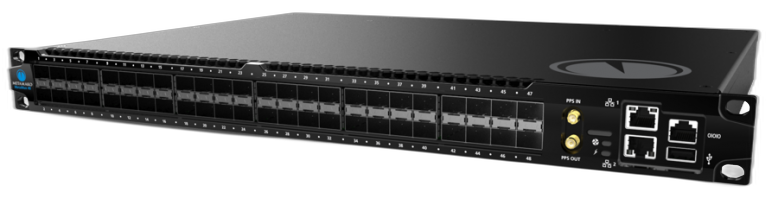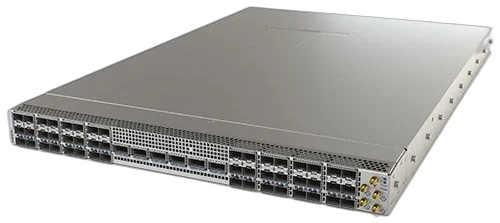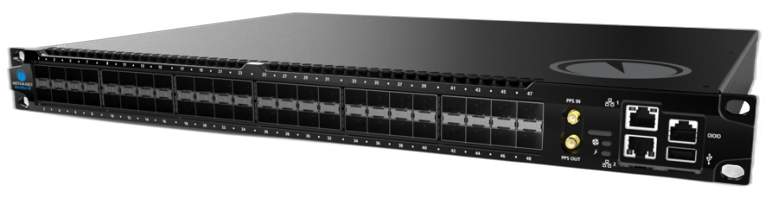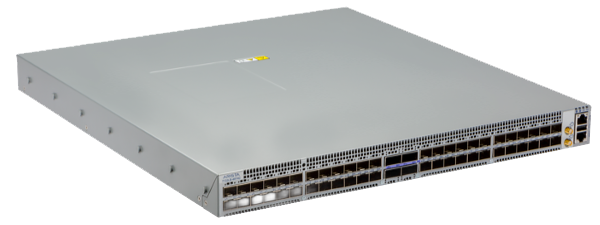
Layer 1 switch delivering 4 ns forwarding with full signal regeneration, non-blocking deterministic operation, and packet replication across SFP+ port configurations up to 96 ports.
The Arista 7130S Connect Series occupies the Layer 1 tier of the switching stack, where the primary engineering constraint is not throughput in the traditional sense but latency in the sub-microsecond range specifically nanoseconds. These switches forward data between ports in 4 nanoseconds with complete signal recovery, meaning the electrical signal is regenerated at each port rather than simply amplified or passed through. Signal regeneration removes accumulated noise and jitter that would otherwise degrade link quality over multi-hop paths, allowing the 7130S to be inserted into trading infrastructure where signal integrity across many hops is as important as raw forwarding speed. Three hardware configurations 16, 48, and 96 SFP+ ports address different deployment scales from compact co-location installations to larger fabric deployments.
Because the 7130S operates at Layer 1, there is no packet buffering, no queue management, and no store-and-forward processing traffic is forwarded as a continuous bitstream between source and destination ports. This eliminates the variable latency introduced by buffer occupancy that affects Layer 2 and Layer 3 switches when congestion causes packets to wait in output queues. The packet-aware management layer adds capabilities beyond simple optical patching: packet replication allows a single input stream to be mirrored to multiple destinations simultaneously for monitoring and analytics, while signal quality monitoring with eye diagram visualisation allows operators to detect degrading optical links before they drop catching a fibre connector that is beginning to fail as attenuated signal levels rather than as a link-down event that disrupts trading operations.
The 7130S forwards traffic between ports in 4 nanoseconds a figure measured from electrical input to electrical output at the Layer 1 crosspoint, not the store-and-forward latency measured at Layer 2 after buffering. This distinction matters for financial trading applications where the latency budget across the entire co-location fabric is measured in tens of nanoseconds: a Layer 2 switch that adds even 200 ns of queuing latency under light load consumes a disproportionate share of that budget, whereas the 7130S contributes a fixed, deterministic 4 ns regardless of traffic load or port count. The forwarding latency is deterministic it does not vary with traffic load, packet size, or the number of other active ports which is the property that makes it suitable for latency-sensitive applications where worst-case latency matters as much as average latency.
At each port, the 7130S fully regenerates the electrical signal reshaping, retiming, and restoring the signal to its original amplitude and waveform rather than simply re-amplifying it. Re-amplification increases signal level but also amplifies accumulated noise and jitter, which compounds across multiple hops until link quality degrades below the receiver's margin. Regeneration eliminates the accumulated noise by recovering the original data and transmitting a clean signal from that point forward, which means the optical link budget calculation for a multi-hop path through 7130S switches is independent at each segment rather than additive. For high-density co-location environments where multiple 7130S switches are cascaded across a rack or row, regeneration is what allows the full cascade depth without link quality degradation.
The 7130S can replicate a single input stream to multiple output ports simultaneously, allowing a single tap of a trading feed to be distributed to multiple consumers a primary trading application, a risk management monitor, a compliance capture system, and a latency measurement tool without introducing additional tap points or passive optical splitters that each add signal loss. Packet replication at Layer 1 delivers identical copies of the bitstream to each destination without the frame duplication and header manipulation that Layer 2 mirroring requires, and without the filtering and sampling limitations that hardware-rate SPAN ports impose under high traffic loads. Media conversion between different optical standards is also supported, allowing 7130S switches to bridge between optical reach requirements within the same forwarding path.
The 7130S provides per-port signal quality monitoring that generates eye diagram visualisations a representation of the signal waveform that shows the separation between logic levels and the timing margin available before bit errors occur. An eye diagram with a wide, clear opening indicates a healthy link with ample margin; a closing or obscured eye indicates a link that is degrading toward the threshold where bit errors begin. This monitoring allows operators to identify a deteriorating fibre connector, a dirty SFP transceiver, or an optical path with excessive loss before the link fails completely, which is particularly valuable in trading environments where an unexpected link failure during market hours has immediate business impact. The monitoring is passive it does not affect the forwarding path or add latency to traffic in flight.
Full specifications for Arista 7130S Connect Series
Download product documentation and resources
Explore other configurations and models that might suit your needs.
Recommended
#DCS-7130LBR-48S6QD-F
Recommended
#DCS-7130-48LS-F
Recommended
#DCS-7132LB-48Y4C
Our team of experts is ready to help you find the perfect solution for your business needs. Get personalized advice and competitive quotes.
We're here to help with any questions