Contact Us (02) 9388 1741
Solve Connectivity Complexity

Solve Connectivity Complexity

Moving a campus off a brittle three-tier design and onto software-driven cloud networking, where EOS, CloudVision, and AVA replace manual troubleshooting with guided, cognitive diagnostics.

Talk to a Specialist

Connectivity complexity accumulates when a network runs different operating systems on different platform tiers: a separate OS for core switching, another for access switching, another for campus, and another for WAN routing. Each OS has its own CLI syntax, its own software release track, its own bug set, and its own configuration model, creating a situation where network engineers must maintain proficiency across multiple vendor operating systems simultaneously, where automation scripts must handle the syntax differences between platforms, and where troubleshooting a problem that spans tiers requires switching between mental models and toolsets mid-investigation. The result is a network that is operationally more expensive per port than an equivalent network built on a consistent operating system, even if the per-port hardware cost was lower at procurement time.

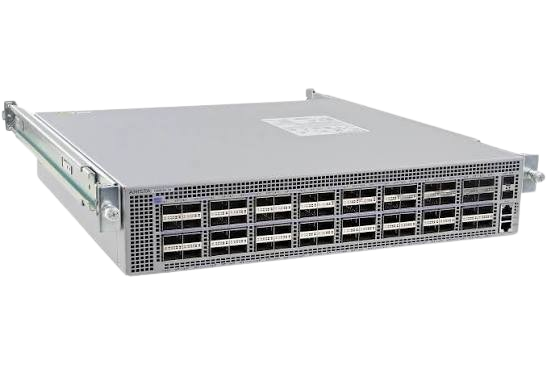
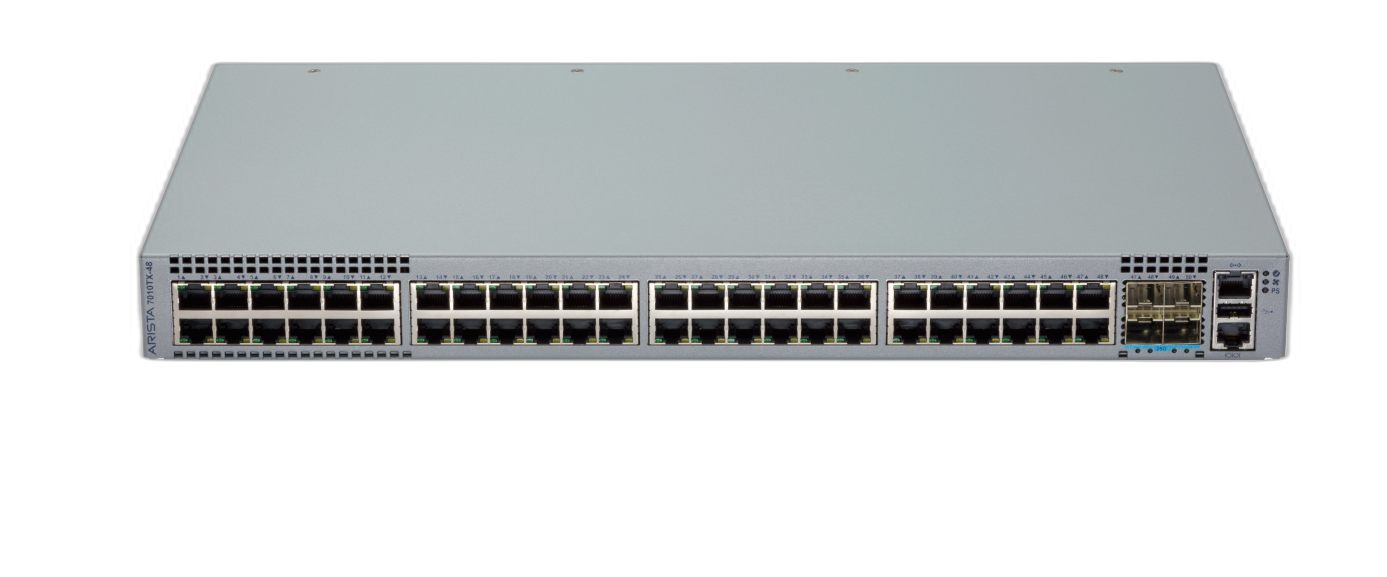
Arista EOS runs as a single binary image across the full range of Arista hardware (from the 7010X at 1/10/25G server access to the 7800R4 at 800G AI spine, from the CCS-720XPM campus PoE switch to the 7280R4 high-capacity WAN router) so that every platform in the network runs the same CLI, the same automation APIs, the same BGP and EVPN implementation, and the same LANZ streaming telemetry framework. UFT (Unified Forwarding Table) provides configurable allocation between MAC table capacity and IPv4 route table capacity on the same hardware: Mode 0 provides 136,000 MACs and 8,000 IPv4 routes for campus access workloads; Mode 4 provides 8,000 MACs and 128,000 IPv4 routes for data centre spine and routing workloads. The same hardware hardware adapts to different deployment roles through software configuration. The 7260X3 two-tier design scales to 27,648 10/25G servers; the 7700R4 non-blocking design scales to 4,608 800G hosts. CloudVision provides the network-wide management and telemetry layer across all EOS platforms, replacing the multiple vendor-specific management tools that a multi-OS network requires.

Single OS Across All Tiers

A single EOS binary image running across every platform in the network (data centre spine, data centre leaf, campus core, campus access, and WAN router) means that an engineer who knows EOS can configure, troubleshoot, and automate any device in the network using the same syntax and the same toolset. This reduces the per-engineer onboarding cost for new platform deployments: a network team that already operates Arista data centre switching adds Arista campus switching without a separate training investment for a different OS. It also reduces the automation development cost: a script that queries EOS streaming telemetry for data centre switches queries campus switches using the same API calls and data schema, rather than requiring a separate integration for each OS.

UFT Table Flexibility

Arista's Unified Forwarding Table (UFT) allows the same switch ASIC to allocate its forwarding table capacity between MAC addresses and IPv4 routes in different ratios depending on the deployment role. UFT Mode 0 (136,000 MACs, 8,000 IPv4 routes) is appropriate for campus access switches that primarily learn end-host MAC addresses; UFT Mode 4 (8,000 MACs, 128,000 IPv4 routes) is appropriate for data centre spine switches that need large IPv4 routing tables for BGP peering with many leaf switches. The ability to reconfigure UFT mode in software means the same physical hardware can be repurposed between deployment roles as network requirements evolve; a switch deployed at the campus access tier can be redeployed at a data centre aggregation tier with a different UFT mode without hardware replacement.

LANZ Nanosecond Telemetry Across the Fabric

LANZ (Latency Analyzer) provides nanosecond-precision buffer depth and queue latency telemetry on every EOS switch in the fabric, streaming that data to CloudVision in real time. Because LANZ is part of EOS rather than a feature of a specific hardware platform, the same telemetry data is available from the 7010X access switch, the 7060X4 leaf, the 7260X3 spine, and the 7800R4 modular chassis, providing a uniform performance visibility layer across every tier of the network. Traditional SNMP-based polling at 1-5 minute intervals captures time-averaged statistics that smooth over microsecond congestion events that cause tail latency; LANZ captures the peak queue depth and duration of each individual micro-burst, providing the evidence required to confirm or exclude network congestion as the source of application performance issues.

Stateful Fault Containment and Live Patching

EOS processes run in separate process isolation containers: routing processes, spanning tree, LLDP, management, and the forwarding pipeline are independent, so a software fault in one process does not crash or freeze the others. If a routing protocol process crashes, it restarts without affecting the forwarding plane or other control plane protocols; the switch continues forwarding traffic for the duration of the restart. Live patching allows individual EOS software components to be updated while the switch is forwarding traffic, without a reboot and without a maintenance window. For network operators who need to apply EOS security patches or bug fixes promptly, the ability to patch specific components live rather than rebooting the switch removes the scheduling friction that would otherwise delay applying patches that require disruption to apply.

Technical Specifications

Full specifications for Solve Connectivity Complexity

Detailed specifications are coming soon — see the datasheet in the Documentation tab for full details in the meantime.

Documentation

Download product documentation and resources

No documentation is currently available for this solution.

Call a Specialist
Today!

Our team of experts is ready to help you find the perfect solution for your business needs. Get personalized advice and competitive quotes.

Monday - Friday: 9:00 AM - 6:00 PM AEST
Sydney, Australia

Speak to an Expert

We're here to help with any questions

Call us now
(02) 9388 1741