What deterministic AI-ready performance actually looks like on the 7010X, 7060X, and 7260X, including port-speed flexibility and how EOS handles self-healing during fabric events.
Talk to a SpecialistAI data centre network designs differ from general-purpose enterprise data centre designs in one fundamental way: the dominant traffic pattern is east-west rather than north-south. In a general-purpose data centre, the majority of traffic flows north-south, from servers to clients through a border router or load balancer. In a GPU training cluster, the dominant traffic is east-west, between GPUs during collective communication operations, where every GPU exchanges gradient data with every other GPU simultaneously. This traffic pattern requires a non-blocking, uniform-latency fabric where every east-west path has the same bandwidth and the same hop count, so that no GPU in a collective operation is consistently slower than the others due to a network bottleneck. The Arista AI data centre reference architecture addresses this requirement through a spine-leaf topology built from switches that are explicitly designed for uniform, lossless, high-bandwidth forwarding at scale.
The reference architecture spans the full port-density and throughput range of the Arista portfolio: 7010X for power-efficient 1/10/25G server access at under 0.3W per Gbps (296 Gbps, 220 Mpps); 7260X3 for high-capacity leaf-spine at up to 12.8 Tbps in 2RU with 64 MB dynamic buffer, scaling to 27,648 10/25G servers in a two-tier design at 3:1 oversubscription; 7700R4 Distributed Etherlink for 800G cross-row spine interconnect scaling to 4,608 non-blocking 800G hosts; and 7800R4 for modular 800G spine in the largest clusters. Latency across the fabric operates in the 550 ns to 1,500 ns range in non-blocking configurations. EOS runs a single binary across all platform tiers, implementing consistent PFC and ECN profiles and providing hitless In-Service Software Updates that allow EOS version upgrades without rebooting switches and disrupting GPU training jobs in flight.
The spine-leaf topology flattens the network to two tiers: leaf switches directly connect servers, and spine switches interconnect leaf switches, so that every server-to-server path traverses exactly two hops (one leaf, one spine, one leaf) regardless of physical location. This uniform hop count delivers predictable latency in the 550 ns to 1,500 ns range for non-blocking traffic, which is the determinism requirement that GPU collective operations need to proceed without stragglers. A 7260X3 two-tier design scales to 27,648 10/25G servers at 3:1 oversubscription, with 64×100G, 256×25G breakout, 258×10G, or 128×50G port options from the same hardware, accommodating mixed server connectivity speeds within the same fabric without requiring separate switch models per speed tier.
PFC (Priority Flow Control) pauses specific traffic classes before buffer exhaustion, preventing packet drops that would cause RoCEv2 retransmissions and GPU idle time. ECN (Explicit Congestion Notification) marks packets earlier in the congestion ramp, giving RoCEv2 endpoints the signal to slow sending before PFC is triggered, reducing the frequency and duration of PFC pause events. EOS implements both mechanisms with configurable per-queue thresholds and per-class marking rates, allowing the tuning to be adjusted for the specific RTT and traffic patterns of each deployment. Field-reversible airflow modules and Platinum-rated PSUs (above 93% efficiency) support the power and cooling requirements of dense GPU row deployments where the switch tier consumes measurable facility power alongside the compute nodes.
The 7260X3 breakout capability (64×100G, 256×25G, 258×10G, or 128×50G from the same switch) allows a single hardware platform to serve different access speeds within the same fabric as server NIC generations change: a rack of servers with 25G NICs connects to the same 7260X3 switch as a rack with 10G NICs, and when those servers are eventually refreshed to 100G NICs, the switch port configuration changes in software without replacing the switch. The 7050X4 provides further port flexibility for mixed-density deployments and 7300X3 modular chassis for aggregation scenarios. This flexibility reduces the hardware churn that would otherwise occur at the access tier each time the server NIC generation changes, allowing the network investment to span multiple server refresh cycles.
In-Service Software Updates (ISSU) allow EOS to be upgraded on a running switch without a reboot: the switch remains forwarding traffic during the update, and control plane state (BGP sessions, OSPF adjacencies, VXLAN tunnels) is preserved across the software transition. For an AI data centre where a training cluster may run a single job for hours or days, the ability to upgrade switch software without disrupting running jobs eliminates the maintenance window requirement that would otherwise force a choice between deferring software updates and interrupting production training workloads. Stateful fault containment isolates failures in individual EOS software processes to prevent them from propagating to other processes or requiring a full switch reboot; a routing protocol crash does not affect the forwarding plane or other control plane protocols running on the same switch.
Full specifications for AI-Ready Data Center
Detailed specifications are coming soon — see the datasheet in the Documentation tab for full details in the meantime.
Download product documentation and resources
No documentation is currently available for this solution.
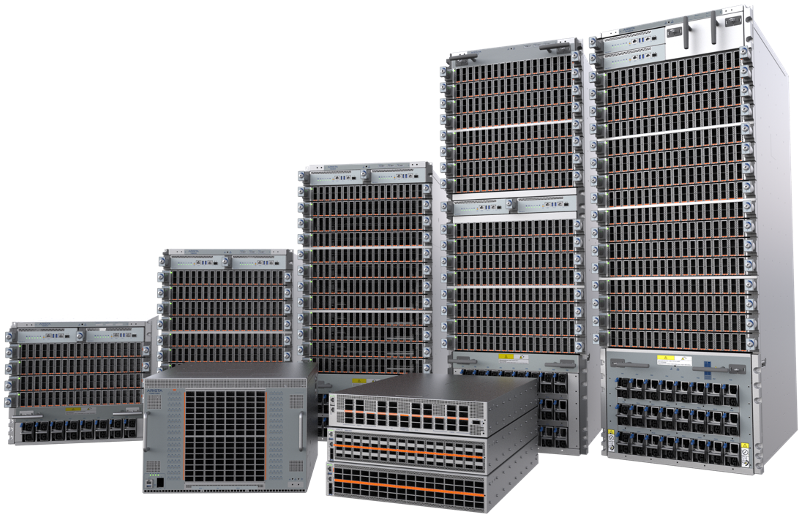
Arista hardware spanning access to 800G spine for AI cluster fabrics.
800G modular spine for the largest AI clusters, providing non-blocking high-radix interconnect at the core tier.
4,608 x 800G non-blocking hosts in a cross-row 2-tier design: a disaggregated spine for maximum scale.
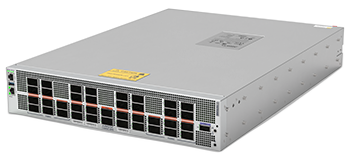
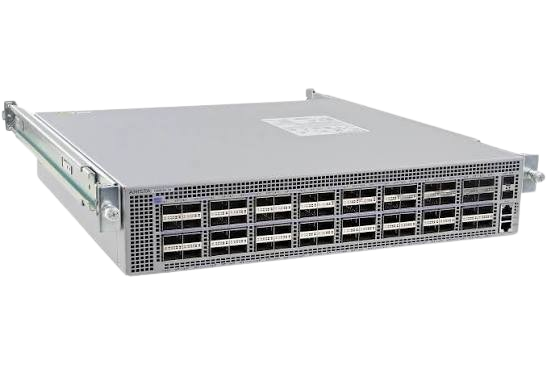
12.8 Tbps in 2RU with 64 MB dynamic buffer and flexible port speeds for mixed-generation server access.
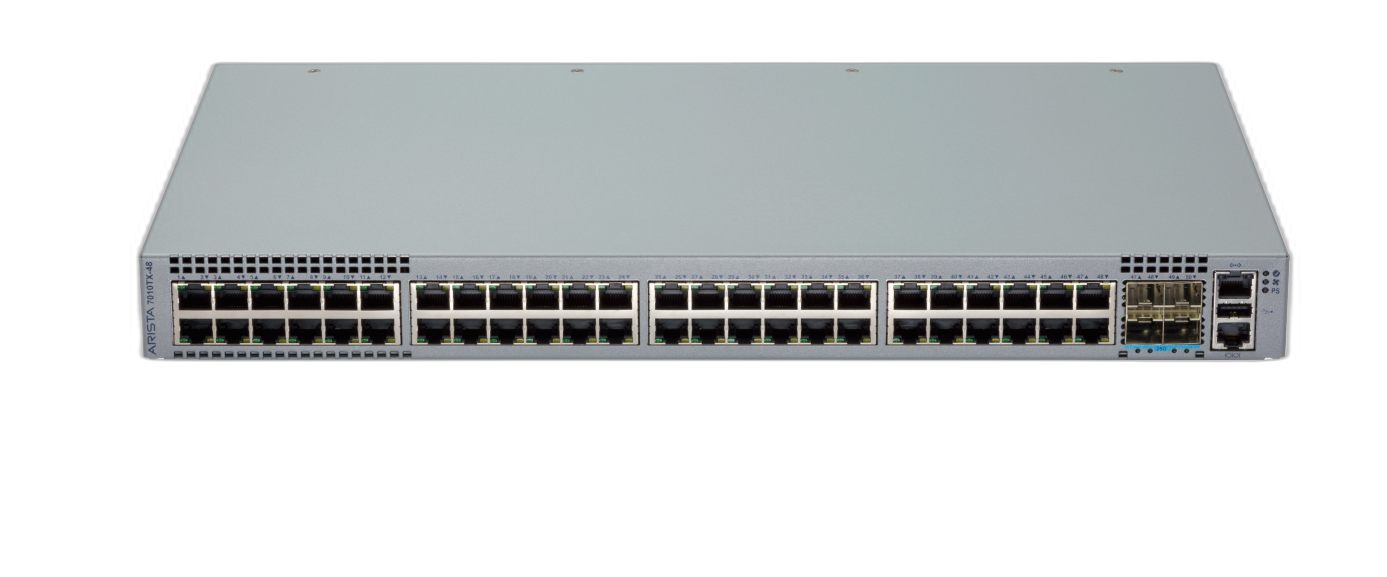
Power-efficient 1/10/25G access at under 0.3W per Gbps, delivering 296 Gbps, 220 Mpps server connectivity.
Our team of experts is ready to help you find the perfect solution for your business needs. Get personalized advice and competitive quotes.
We're here to help with any questions