Standardizing on one EOS image across data center, campus, and WAN to eliminate configuration drift, version sprawl, and the manual overhead of separate operating systems.
Talk to a SpecialistThe operational tax of a fragmented network operating environment accumulates from each additional OS instance that must be managed in parallel: separate software release tracks with separate vulnerability patch cycles; separate training requirements for engineers who must operate all of them; separate automation frameworks because each OS exposes a different API and a different data model; and separate management tools because no single management platform handles every vendor's OS equally well. Each OS boundary also creates a troubleshooting discontinuity: when investigating a performance problem that spans a boundary between two OS domains, the operator must shift mental model, toolset, and CLI syntax mid-investigation, adding time and potential for error at the moment when speed and accuracy matter most. The operational tax is not always visible on a single-quarter budget, but it is consistently present in headcount, consulting spend, tooling licences, and mean-time-to-resolution for cross-domain incidents.
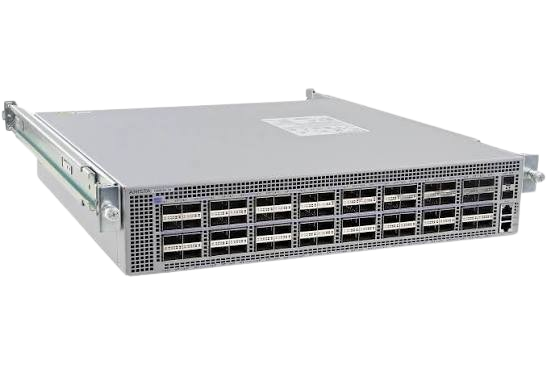
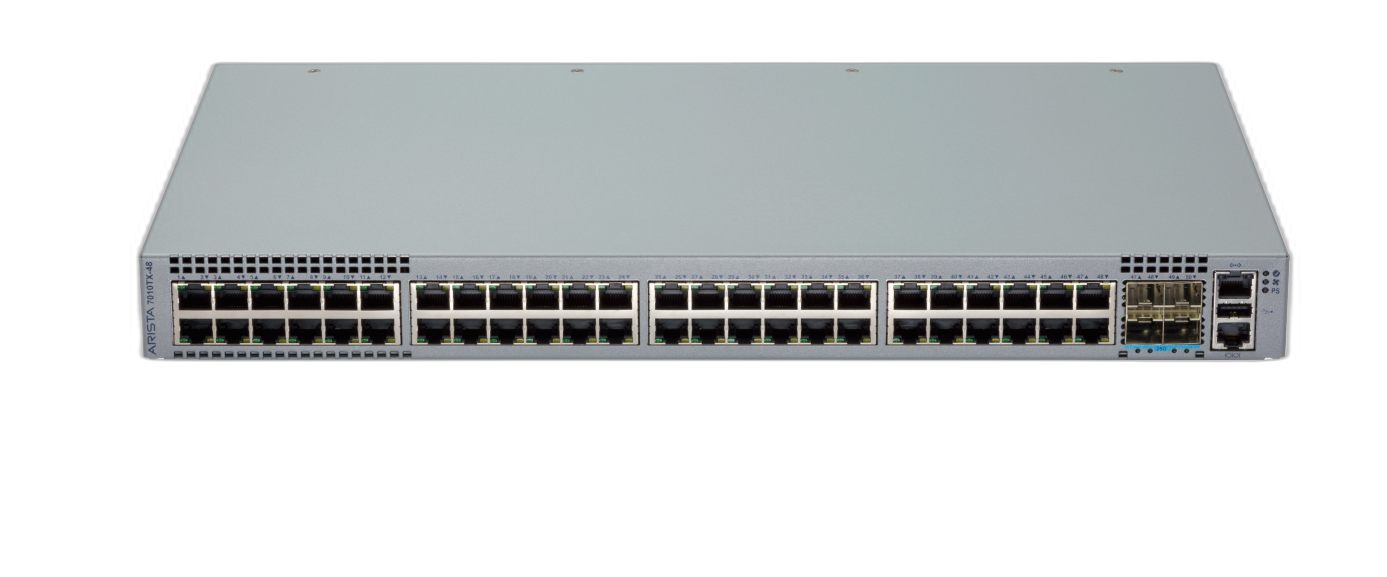
Arista EOS eliminates OS fragmentation through a single binary image that runs across the full hardware range: the 7010X at 1/10/25G server access (296 Gbps, 220 Mpps, under 0.3W/Gbps), the 7260X3 at 100G leaf-spine (12.8 Tbps, 2RU, 64 MB buffer, sub-1,500 ns latency, scaling to 27,648 servers in a 2-tier 3:1 design), the 7260CX-64 (64×100G in 2RU for high-density leaf), the 7050X for 110,000+ 10G server scale, the 7700R4 for 4,608×800G non-blocking AI spine, and the 7800R3 for large-scale modular aggregation. UFT Mode 0 allocates 136,000 MACs and 8,000 IPv4 routes for campus access workloads; UFT Mode 4 provides 8,000 MACs and 128,000 IPv4 routes for routing-intensive spine deployments; the same hardware adapts to each role in software. Platinum-rated PSUs at above 93% efficiency and field-reversible airflow reduce per-port power draw across all tiers. Live patching applies EOS software updates to running processes without a reboot; stateful fault containment isolates process failures to prevent them from cascading. CloudVision provides the consistent management, ZTP, and telemetry plane across all EOS platforms, replacing the siloed management tools that a multi-OS environment requires.
Because all Arista switches run EOS, every switch in the network exposes the same gNMI streaming telemetry API, the same OpenConfig data models, and the same eAPI JSON interface, so automation scripts written for data centre switches work without modification on campus switches and WAN routers. This eliminates the parallel automation framework problem that occurs when different OS instances expose different APIs: a multi-vendor environment requires either a separate automation script per OS family or a normalisation layer that abstracts the differences, both of which add maintenance overhead. With EOS, normalisation is not required: the same Ansible playbook, Terraform provider, or Python script that manages the data centre spine manages the campus access switch and the branch router, using the same connection method and the same data model throughout.
A single EOS software release addresses vulnerabilities and defects across all Arista platforms simultaneously: there is one release to evaluate, one compatibility matrix to check, and one upgrade plan to execute, rather than a separate evaluation and upgrade cycle per OS family per tier. For security patches that address critical vulnerabilities, the time from patch availability to deployment completion is a direct function of how many independent OS instances must be patched: a network with one OS requires one coordination effort; a network with four OS families requires four coordination efforts running sequentially or in parallel. EOS live patching allows individual components to be updated without a full switch reboot, further reducing the disruption cost of maintaining a current patch level. The operational tax of maintaining security hygiene is lower when the patching mechanism is less disruptive per device.
UFT (Unified Forwarding Table) reconfigures the same switch ASIC's forwarding table allocation between MAC addresses and IPv4 routes through a software mode setting, rather than requiring a different hardware platform for each deployment role. When a campus access switch (deployed with UFT Mode 0 for high MAC capacity) is repurposed as a data centre aggregation switch (which needs higher IPv4 route capacity), the UFT mode is changed in EOS configuration without replacing the hardware. This flexibility extends the useful life of the hardware investment across changing network roles, a significant operational benefit in large networks where repurposing switches as requirements change would otherwise require procurement of role-specific hardware. UFT mode flexibility also allows the same hardware to be stocked as a general-purpose spare that can be deployed into any role, rather than maintaining separate spare pools per platform type.
Zero Touch Provisioning (ZTP) allows new Arista switches to be deployed without pre-staging configuration on each device: the switch connects to the network, contacts CloudVision, and receives its configuration automatically based on its serial number and the site template defined in CloudVision. For large-scale deployments where racking, cabling, and powering hundreds of switches is already labour-intensive, ZTP eliminates the per-switch configuration session from the deployment workflow, so each switch is plugged in and comes up correctly without an engineer connecting to it individually. CloudVision provides configuration management, compliance checking, and software image management across all EOS platforms from a single interface, replacing the per-vendor management tools that a multi-OS environment requires and providing the audit trail of configuration changes that network operations and security teams need for change tracking and incident investigation.
Full specifications for End the Operational Tax
Detailed specifications are coming soon — see the datasheet in the Documentation tab for full details in the meantime.
Download product documentation and resources
No documentation is currently available for this solution.
Arista hardware running a single EOS binary across the full network stack.
The single EOS binary spanning access to 800G spine — one release track, one API model, one automation framework across the full network.
Network-wide ZTP, configuration management, and telemetry across all EOS platforms — replacing per-vendor management silos.
12.8 Tbps 2RU spine — 27,648 server scale, UFT mode configurable, sub-1,500 ns latency, single EOS binary.
Power-efficient 1/10/25G access — 296 Gbps, 220 Mpps, EOS entry point at under 0.3W per Gbps.
Our team of experts is ready to help you find the perfect solution for your business needs. Get personalized advice and competitive quotes.
We're here to help with any questions